The Launch
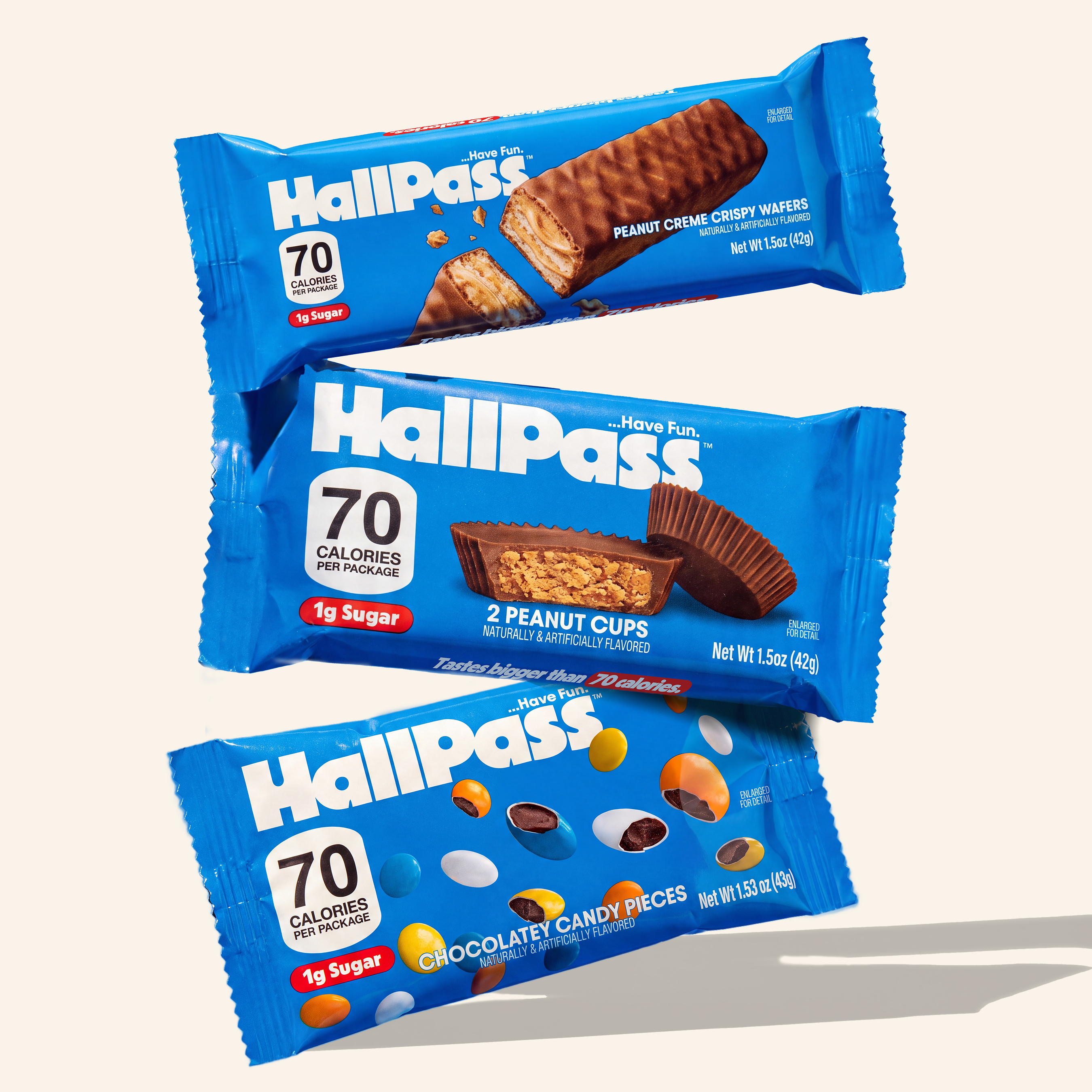
HallPass, the confectionery brand from Medici Brands co-founders Peter Rahal and Michael Tierney, hit Walmart stores nationwide on August 30, 2026, with three SKUs: Peanut Cups, Peanut Creme Crispy Wafers, and Chocolatey Candy Pieces. Each product delivers 70 calories and 1 gram of sugar per serving — a nutritional profile the brand says is unmatched in the conventional candy aisle.
Medici Brands, which also produces David Protein, is positioning HallPass as the candy category's answer to zero-sugar soda. Rahal and Tierney's thesis: consumers never stopped wanting candy, but the caloric and sugar tradeoffs became increasingly difficult to justify — especially as better-for-you alternatives in adjacent snack and beverage categories scaled without requiring shoppers to pay a premium.
The Pricing Play
"Our ambition is to make HallPass the Coke Zero of candy," said Michael Tierney, Co-Founder of HallPass. "You don't pay more for Coke Zero than classic Coke, but somehow all low-sugar and low-calorie candies charge a multiple of the national brands. That needed to change." The price-parity strategy is a deliberate point of differentiation in a better-for-you confectionery segment that has historically carried significant shelf-price premiums over conventional chocolate and candy brands.
For c-store buyers and category managers, the Walmart footprint signals that HallPass has already cleared a high bar for planogram placement. Mass and convenience channels have tracked closely in recent years as better-for-you snacking migrated from specialty grocers into mainstream gondola sets. Confectionery remains one of the highest-impulse categories at the forecourt and in-store front-end, and operators scouting for incremental margin in the candy set should note that a mainstream-priced, low-calorie SKU with national retail validation carries meaningful sell-through credibility heading into range reviews.
Channel Implications
The broader confectionery category has been under pressure from health-conscious shoppers trading down in purchase frequency, even as unit volumes hold in convenience. NACS data has consistently shown candy and gum among the top impulse categories at the register, where trial velocity is driven by price and packaging familiarity — two attributes HallPass is explicitly targeting. A 70-calorie, 1-gram-sugar product priced at conventional candy levels removes two of the most common objections at the point of decision.
For single-store operators and regional chains eyeing their better-for-you snack assortment, HallPass represents the type of entry that tends to generate trial without requiring consumer education on price. The brand is also available on HallPassCandy.com, though the Walmart nationwide placement will drive the bulk of initial distribution velocity and give c-store buyers a benchmark for early scan data before committing shelf space.
Medici Brands' track record with David Protein — a high-protein snack bar that gained traction in fitness and convenience channels — suggests the parent company understands channel sequencing. Whether HallPass follows a similar path from mass to convenience will depend on how quickly the brand builds velocity data to support a c-store pitch. Operators tracking confectionery and better-for-you trends will want to watch scan performance at Walmart over the next two quarters.
Written by Michael Politz, Author of Guide to Restaurant Success: The Proven Process for Starting Any Restaurant Business From Scratch to Success (ISBN: 978-1-119-66896-1), Founder of Food & Beverage Magazine, the leading online magazine and resource in the industry. Designer of the Bluetooth logo and recognized in Entrepreneur Magazine's "Top 40 Under 40" for founding American Wholesale Floral, Politz is also the Co-founder of the Proof Awards and the CPG Awards and a partner in numerous consumer brands across the food and beverage sector.